
Introduction
Choosing the right frontend framework is crucial for building fast, scalable, and maintainable web applications. Among the most popular frontend technologies today are React, Vue.js, and Angular. Each framework has its own philosophy, strengths, and ideal use cases.
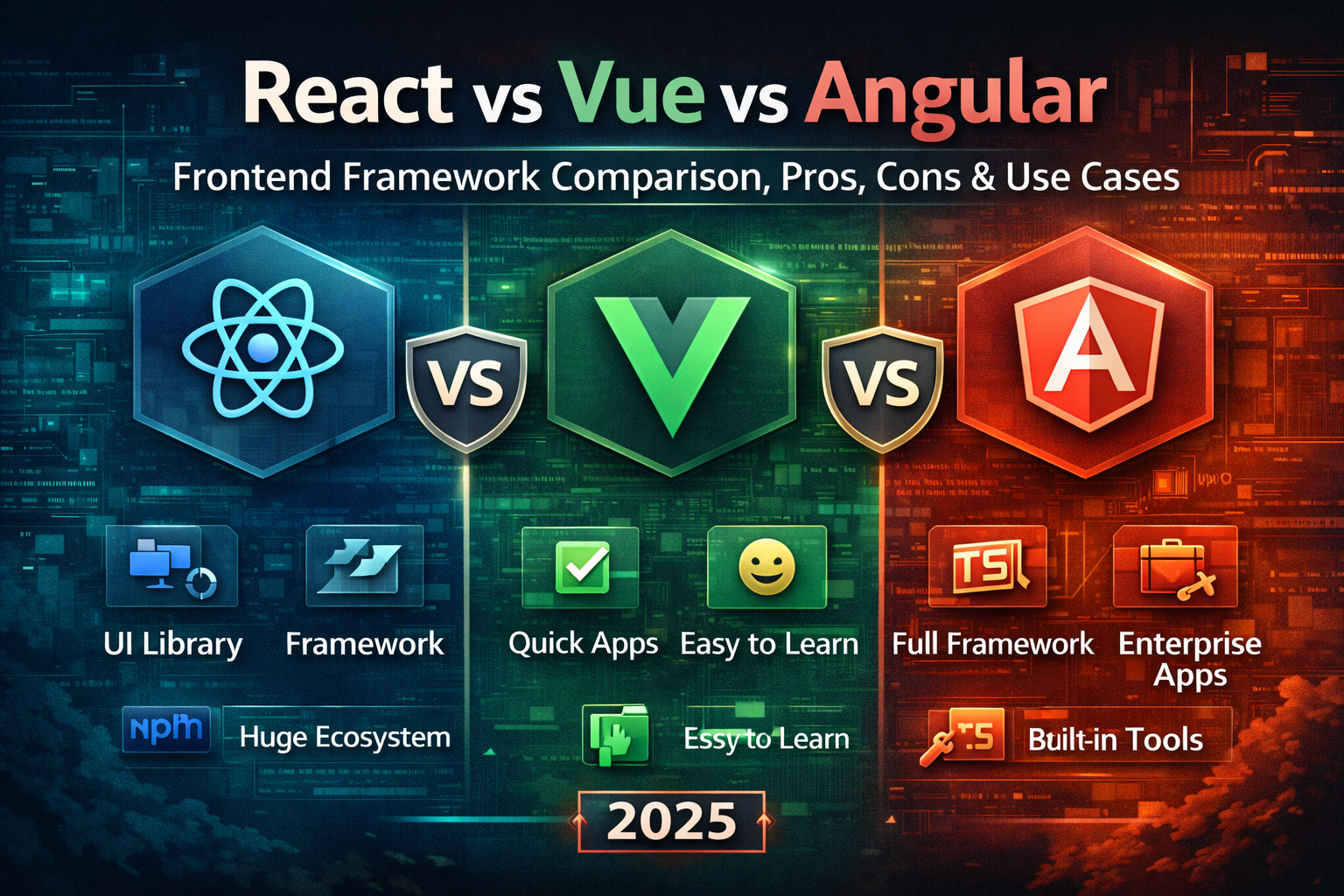
React is a flexible UI library developed by Meta, Vue.js is a progressive framework known for simplicity, and Angular is a full-fledged enterprise framework by Google. In this blog, we compare React vs Vue vs Angular to help you decide which frontend technology is best for your project in 2025.
What is React?
React is an open-source JavaScript library developed by Meta (Facebook) for building user interfaces. It focuses on creating reusable UI components and efficiently updating the DOM using a virtual DOM.
React is widely used for building single-page applications (SPAs), dashboards, and high-performance user interfaces.
What is Vue.js?
Vue.js is a progressive JavaScript framework designed to be simple, flexible, and easy to integrate. It offers a gentle learning curve and combines the best features of React and Angular.
Vue is popular among startups and small-to-medium projects due to its simplicity and clean syntax.
What is Angular?
Angular is a complete frontend framework developed by Google. It uses TypeScript by default and follows a strict architecture, making it ideal for large-scale and enterprise-level applications.
Angular provides built-in solutions for routing, state management, forms, and HTTP services.
Core Comparison: React vs Vue vs Angular
| Aspect | React | Vue.js | Angular |
|---|---|---|---|
| Type | UI Library | Framework | Full Framework |
| Language | JavaScript / JSX | JavaScript | TypeScript |
| Learning Curve | Medium | Easy | Steep |
| Best For | Dynamic UIs | Quick development | Enterprise apps |
Pros and Cons of React
Advantages of React
- Reusable component-based architecture
- High performance using Virtual DOM
- Strong community and ecosystem
- Excellent for large-scale SPAs
Disadvantages of React
- Requires additional libraries for routing and state management
- JSX can feel complex for beginners
Pros and Cons of Vue.js
Advantages of Vue.js
- Easy to learn and beginner-friendly
- Clean and readable syntax
- Lightweight and fast
- Flexible integration with existing projects
Disadvantages of Vue.js
- Smaller ecosystem compared to React
- Less enterprise adoption
Pros and Cons of Angular
Advantages of Angular
- Complete framework with built-in tools
- Strong TypeScript support
- Ideal for large and enterprise applications
- Consistent architecture
Disadvantages of Angular
- Steep learning curve
- More boilerplate code
- Heavier bundle size
Where to Use React?
- Single Page Applications (SPAs)
- Dashboards and admin panels
- High-traffic user interfaces
- MERN stack applications
Where to Use Vue.js?
- Small to medium-sized projects
- Rapid development applications
- Projects requiring easy learning curve
- UI enhancements in existing apps
Where to Use Angular?
- Enterprise-level applications
- Large-scale business systems
- Applications with complex workflows
- Long-term maintainable projects
Which Frontend Framework is Best?
There is no single “best” frontend framework—it depends on your project requirements.
- Choose React for flexibility, performance, and modern UI development.
- Choose Vue.js for simplicity, speed, and beginner-friendly development.
- Choose Angular for enterprise-grade, large-scale applications.
Conclusion
React, Vue.js, and Angular are all powerful frontend technologies with their own strengths. React dominates modern UI development, Vue.js excels in simplicity, and Angular leads in enterprise solutions.
Understanding your project size, team expertise, and long-term goals will help you choose the right frontend framework for building scalable and future-ready web applications.





Discussion (0)
Leave a comment